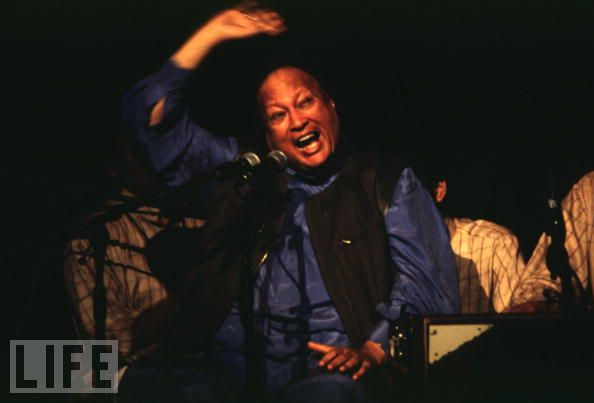
Singing in Urdu and his native Punjabi, as well as Persian, and blending traditional stylings with a vast array of outside textures, Nusrat is much credited for the modern evolution of Qawwali. Although not the first to do so, he popularized the blending of khayal singing and techniques with Qawwali; this in short took the form of improvised solos during the songs using the sargam technique, in which the performer sings the names of the notes he is singing.
Despite Nusrat’s unique style, his songs usually did not deviate too far from the art form’s standard template. The normal structure of a Qawwali song begins with a short instrumental prelude played on the harmonium and tabla. Then the instruments stop, and the main singers (but not the chorus) launch into the alap, which establishes the raga, or the tonal structure of the song. At this point, introductory poetic verses are sung. These are usually drawn not from the main song, but from other thematically related songs. The melody is then improvised within the structure of the raga. This improvisation has been explained as the improviser acting as a direct vessel, or channel, of the spiritual realm.
After the introductory verses, the rhythmic portion of the song begins. The tabla and dholak begin to play, and the chorus aids and abets the percussion by clapping their hands. From there, the song proceeds in a call-and-response format. This loose, though structured format explains why the same song may be sung quite differently by different groups though still maintain its basic essence. The lyrics will be essentially the same, but the melody can differ depending on which gharana or lineage the group belongs to. As is the custom in the Qawwali form, Nusrat and the side-singers will interject alap solos and fragments of other poems or even improvised lyrics. A song usually has two or three sets of refrains, which can be compared to the verse-chorus structure found in western music. Songs last about 20 minutes on average, with some lasting an hour or even more.
Nusrat was noted for introducing other forms of improvisation into the standard style. From his classical music training, he would interject much more complex alap improvisations, with more vibrato and note bending. His interjection of sargam improvisations was also quite unique.
Lets listen to Rahat’s Explanation on NFAK’s Music
“Unhone ek guldasta banaaya,” says Rahat. “Usme qawwali, thumri, ghazal, muktalif kism ki musical forms ko shaamil kiya.” Nusrat made a bouquet of musical styles, but unlike what the purists say, he did not compromise while doing that. “Everthing he did retained the flavour of qawwali,” says Rahat. The essence of his music, in other words, drew from the same spiritual yearning that marks out qawwali music.
One of the biggest gripes around Nusrat – and, indeed, against Rahat today – is that he demeaned qawwali music by taking it out of its original setting of dargahs and suchlike, and into marriage functions and Bollywood. I ask Rahat about that, about how one can reconcile the original intent of qawwali as a spiritual tool with its use today for entertainment.
“You can listen to every qawwali in two ways,” he tells me. “When we sing of ‘sharaab’ and ‘suroor’, you can take the meaning to be either literal, or a metaphor for something spiritual. It depends on the person listening to it, not on the setting.”
In 1985, Nusrat performed at a festival in Cornwall, and that is where the West sat up and took notice of him. As the years went by, collaborations, albums and concerts followed, most notably his remarkable series of albums with Real World.
“Did he adapt his music for Western Audiences?” I ask Rahat. “Was there a difference between the music he performed in Pakistan and that abroad?”
“There had to be,” says Rahat. “The music he performed abroad had much more of classical content. Foreigners didn’t understand our language and our lyrics, so the music had to work harder.”
Also, if I may speculate, foreigners unused to classical music were likely to be far more impressed by meandering alaaps than local audiences, who had seen plenty of that stuff, and whose expectations from the music were often different. In other words, Nusrat perhaps played to his Western audiences a bit, gave them the exotica he craved – but always without compromising the essence of his music.
I ask Rahat about Star Rise, the Real World compilation of some of Nusrat’s music remixed by stars of the Asian Underground. It’s the only work featuring Nusrat’s voice that I simply can’t stand, and I ask Rahat what Nusrat thought of such remixes. Rahat laughs. “Nusrat hated it,” he says. “He felt they had destroyed his music.”
Posted on November 30, 2024
| 7 minutes
| 1294 words
| admin
1Allah HooThe most Divine Nusrat Fateh Ali Khan’s Song Ever… it made me feel the Existence of God None Other than …" Allah Hoo " This unforgettable piece was recorded in 1993, Washington, USA/ Don’t forget to close your eyes and switch off the light to experience the divinity of the song…2Ye Jo Halka HalkaAnd now comes the most intoxicating song ever, Jeff Buckley one said that this was the song that saved his life , I myself have a few personal stories … but that’s for some other time… you might have guessed that it’s none other than “Ye Jo Halka Halka Suroor Hai”, choosing the best recorded version of this song is next to impossible for me , I have heard this song in all possible lengths , from 5mins to 68 minutes versions…3Mast Mast (Dam Mast Qalandar)Mast Mast , was probably the most popular and Loved NFAK song ever. Best suited for the dance of ecstasy. Many versions of this song will take positions in top 100(or top 50) .4Haq Ali Ali (Ali Maula Ali Maula) , the second most powerful Traditional Qawwali of NFAK, People have been seen banging their heads , in total trans, listening to this song.. this was NFAK’s first recording in in 1972 i guess, and initially became a massive hit in Faisalabad and other parts of PunjabHaq Ali Ali(Ali Maula Ali Maula)5[Read More]
Posted on November 28, 2017
| 1 minutes
| 65 words
| admin
The advent of online music services has proved a boon for us music fanatics! We will be updating this page to provide legal links to all the Nusrat Fateh Ali Khan Albums Available OnlineClick Here to Listen to Huge NFAK Collection on GroovesharkClick Here to Listen to NFAK Collection on Sound CloudGanna.com is a new Indian Napster & it’s getting awesome day by day
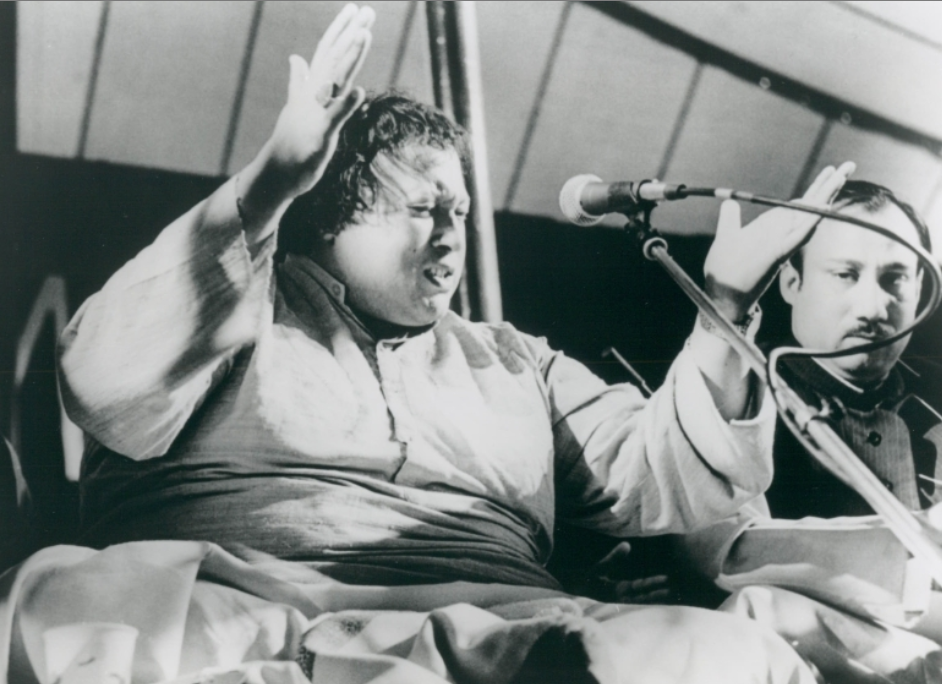
 , the Real World compilation of some of Nusrat’s music remixed by stars of the Asian Underground. It’s the only work featuring Nusrat’s voice that I simply can’t stand, and I ask Rahat what Nusrat thought of such remixes. Rahat laughs. “Nusrat hated it,” he says. “He felt they had destroyed his music.”